Posts

Showing posts with the label heartbreak

The Conversational Nature of Reality (David Whyte)
Image
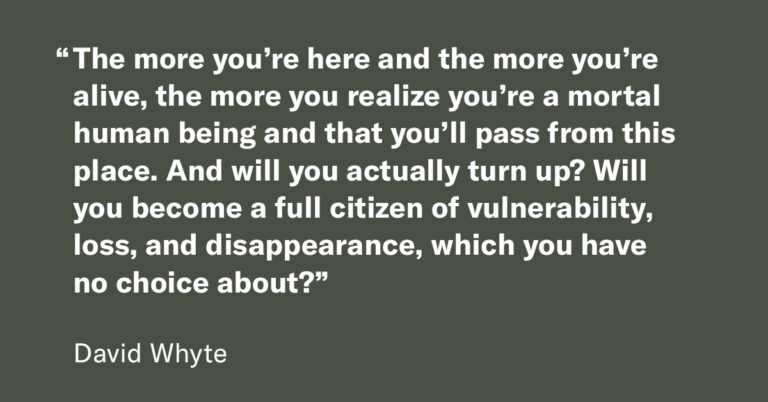
  David Whyte The Conversational Nature of Reality One of the things the Irish say is that “The thing about the past is, it’s not the past.” [ laughs ] It’s right here, in this room, in this conversation. Of course, my work as a poet and philosopher has matured into working with what I call “the conversational nature of reality,” which is the fact that we don’t get to choose so often between things we hope we can choose between. Yes, I went back into poetry because I felt like scientific language wasn’t precise enough to describe the experiences that I had in Galapagos. Science, rightly, is always trying to remove the “I.” But I was really interested in the way that the “I” deepened the more you paid attention. I began to realize that my identity depended not upon any beliefs I had, inherited beliefs or manufactured beliefs, but my identity actually depended on how much attention I was paying to things that were other than myself — and that as you deepen this intentionality and thi...

Heartbreak

Image
HEARTBREAK is unpreventable; the natural outcome of caring for people and things over which we have no control, of holding in our affections those who inevitably move beyond our line of sight. Heartbreak begins the moment we are asked to let go but cannot, in other words, it colors and inhabits and magnifies each and every day; heartbreak is not a visitation, but a path that human beings follow through even the most average life. Heartbreak is our indication of sincerity: in a love relationship, in a work, in trying to learn a musical instrument, in the attempt to shape a better more generous self. Heartbreak is the beautifully helpless side of love and affection and is just as much an essence and emblem of care as the spiritual athlete’s quick but abstract ability to let go. Heartbreak has its own way of inhabiting time and its own beautiful and trying patience in coming and going. Heartbreak is inescapable; yet we use the word as if it only occurs when things have gone wrong: an un...